












|
 |

Mermaids
Folk tales about mysterious creatures of the sea have been part of the oral tradition of many countries. Early wood engravings, folk songs, and stories describe mysterious female creatures glimpsed by sailors on their long voyages or even in harbors. Some of these creatures were feared as the sirens and Lorelei of myth—creatures with the bodies of birds and the heads of women, who with their sweet songs could lure men to watery deaths.
Reports of mermaid sightings by explorers and sailors were surprisingly common. The creatures were described as having the torso and head of a woman, but the tail of a fish. Sometimes they were said to save sailors from drowning; at other times they were depicted as malicious creatures with powers to entrap seafarers. In some tales, mermaids frolicked near a ship, charming the sailors with their beauty and playfulness. As with the unicorn, drawings and stories of these fantastic creatures continue to capture the human imagination.
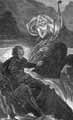
The Lorelei,1869
FromHarper's Weekly,
January 16, 1869
The Mariners' Museum Research Library and Archives
|
|
The Lorelei
"Flows the Rhine as flowing wine,
Bright in its unrest,
Sweet with odors of the vine;
天堂的乳房。”
So the boatman Hugo sung,
Long, long ago,
By the Lurley-berg that hung
In the sunset glow.
At that fateful rock, upraised
From its foamy base,
Suddenly the boatman gazed
With a stricken face.
On its summit, wondrous fair,
Shining angel-wise,
Sat a maid, with golden hair
And beseeching eyes.
From a shoulder's rosy sphere
All the robe that slid,
Ripple bright and water-clear,
Rather show'd than hid.
As her hair her fingers through
(Fingers pearly white)
Slowly pass'd, the diamond dew
Fell and broke in light.
But a gold harp from her feet
Lifted she ere long,
And its music, pulsing sweet,
Fed a wondrous song.
And the boatman, drifting fast,
Listen'd to his cost;
On the rocks before him cast!
In the whirlpool lost!
Then the Lorelei's luring form
Faded from the eye,
As a cloud fades, rosy warm,
In a purple sky.
|
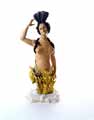 |
Mermaid with Shell Figurehead
The Mariners' Museum
|
 |
Captain Hailborne at St. Johns Newfoundland,
1655 FromNewe Welt und Americanische Historian
by Ludwig Gottfried
The Mariners' Museum
|
This figurehead is believed to be from the vesselVigilantof St. Croix, Virgin Islands. Like many of her sisters, this mermaid was shown bare-breasted, perhaps in the belief that a woman "uncovering her body" could calm the seas.
This morning one of our companie looking over boord saw a Mermaid . . . from Navill upward, her back and breasts were like a woman's (as they say that saw her) her body as big as one of us; her skin very white; and long haire hanging down behinde, of color blacke; in her going downe they saw her tayle, which was like the tayle of a porposse and speckled like a Macrell.
—From Henry Hudson's logbook, June 15, 1608
The day before, when the Admiral was going to the Rio del Oro, he said he saw three mermaids who came quite high out of the water but were not as pretty as they are depicted, for somehow in the face they look like men. He said that he saw some in Guinea on the coast of Manegueta.
—From the Diary of Christopher Columbus, January 9, 1493
When Captain Hailbourne approached the coast of Newfoundland, he supposedly encountered mermaids who seemed to beckon to him. Christopher Columbus and Captain John Smith both mentioned sightings of mermaids, and both remarked that the mermaids they saw were not as beautiful as artists' depictions.
Activity:
After looking at the mermaid figurehead, make up your own story about a mermaid encountered at sea.
Would she be good or bad? After reading about mermaid sightings by explorers, what do you think they were really seeing? Was it an animal, a mirage, or clouds? Write a paragraph that supports your thesis.
|
|
Section 2 of 4 |Next Page >>
|
|


