
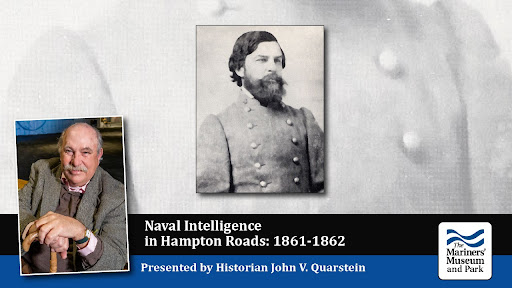
Naval Intelligence in Hampton Roads: 1861-1862

Posted on
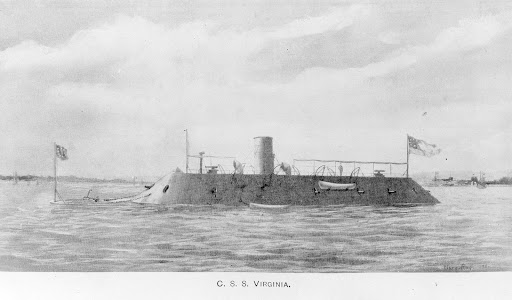
CSS Virginia.
The Mariners’ Museum.

There was no formal naval intelligence system established during the American Civil War. While a few examples exist of Northern sympathizers, free Blacks, like Mary Louvestre of Portsmouth, sent messages to various Union commanders about the Confederate ironclad construction effort. These links were unofficial and were generally between one Union officer and an individual. The Union nor the Confederacy needed to rely on such clandestine methods since Northern and Southern newspapers provided ample information, usually in a boastful manner. Each antagonist simply needed to obtain a copy ofThe New York TimesorMobile Registerto gather all they needed to know about ironclad development.

Union intelligence was able to receive valuable knowledge about theconstruction and impending attack of CSSVirginia. The information appeared to flow back and forth across Hampton Roads. On October 6, 1861, Major General John Ellis Wool, stationed at Fort Monroe as commander of the Union Department of Virginia, wrote to Lieutenant General Winfield Scott:Read more

USS Cumberland – Sink Before Surrender

Posted on
U.S. Frigate Cumberland. Lithograph. Published by Currier & Ives,
ca. 1843-1848. Courtesy of Library of Congress.

USSCumberland,flagship of the US Navy’s Home Squadron, was dispatched to Gosport Navy Yard, Portsmouth, Virginia, upon the sloop’s return from a brief cruise to Veracruz, Mexico. It was hoped that the warship’s presence would deter any effort to capture the yard during the secession crisis. Gosport was the largest and most advanced navy yard in the United States. Besides its granite dry dock and other ship repair/construction facilities, Gosport housed 14 warships, including the steam screw frigate USS Merrimackawaiting repair and others in ordinary like USSRaritan. TheCumberland, then commanded by Captain Garrett J. Pendergrast, was anchored just off Gosport so its firepower could be utilized to defend the yard or cover the release of ships.

Three days afterVirginialeft the Union on April 17, the Union abandoned the yard.Cumberland’screw helped to destroy the facility and various ships. By 4:20 a.m. on April 21,Cumberland, loaded with sailors and Marines, was towed out of the yard by USSPawnee支持的拖船USS Yankee.Cumberlandslowly passed the burningMerrimack,not realizing that what seemed to be a burning hulk would become the sloop’s death knell less than one year later.Read more

The First Ironclad Emerges: Battle of the Head of Passes

Posted on
Confederate 6.4-inch banded rifle, 1862. This is the weapon type used as the bow pivot gun on CSS Ivy. Note the 100-pound conical projectile at the right rear of the gun carriage. Courtesy of Library of Congress, CWPB 01053.

When the Civil War erupted, Confederate Secretary of the Navy Stephen Russell Mallory knew that the South could only counter and defeat the larger US Navy if ironclads were employed. Mallory immediately ordered the construction of ironclads. The first project was the conversion of USSMerrimackinto CSSVirginiaat the Gosport Navy Yard, Portsmouth, Virginia. Mallory then ordered two ironclads laid down in New Orleans, and another two built in Memphis, Tennessee. These vessels could not be built fast enough to stem the Union’s advance against Confederate ports.

Ironclad Imagined

The urgent need for ironclads was recognized by New Orleans Commission Agent Captain John Stephenson who also served as secretary of the New Orleans Pilots’ Benevolent Association. Stephenson went to meet with President Jefferson Davis in Montgomery, Alabama, to ask for the use of a heavy tug, altering it to make it “comparatively safe against the heaviest guns afloat, and by preparing … bow in a peculiar manner … rendered them capable of sinking by collision the heaviest vessels ever built.” With Davis’s approval, Stevenson returned to New Orleans to build an ironclad privateer, quickly raising more than $100,000 in subscriptions.Read more

Gosport Navy Yard is Captured

Posted on
The Navy Yard at Norfolk. Harper’s Weekly, 1861. Courtesy Library of Congress.

The crisis at Gosport had reached its zenith by the morning of April 20, 1861. Flag Officer Charles Stewart McCauley appeared to have given up all hope of saving or defending Gosport Navy Yard. Early that morning, he learned that militia troops had seized Fort Norfolk and an extremely useful magazine filled more than 250,000 pounds of gunpowder. Therefore, McCauley believed he had no choice but to destroy the shipyard so that it would not fall into the hands of the Virginians.

Escape PlanRead more

Siege of Yorktown: The Navies

Posted on
The Siege of Yorktown, April 1862. Ch. Worret, contributor. Courtesy Library of Congress.
CSSVirginiaEnables the 1862 Defense of Yorktown

In spring 1862, Union general George Brinton McClellan had assembled a very powerful army around Washington, D.C. The Union had already recently achieved several major victories along the Mississippi River and its tributaries, as well as they had captured the North Carolina Sounds. McClellan’s army was poised and ready to strike at the Confederate capital at Richmond, Virginia. General McClellan, often called ‘Young Napoleon’ or ‘Little Mac,’ wanted nothing to do with a march overland toward Richmond.

This path was blocked by General Joseph E. ‘Joe’ Johnston’s 45,000-strong army defending Manassas. In an effort to flank and isolate Johnston’s army away from Richmond, McClellan conceived the Urbanna Plan to move his army to the Rappahannock River at Urbanna, Virginia, and then strike directly at Richmond. Before the Union general could implement his campaign, Joe Johnston abandoned his Manassas defenses beginning March 6, 1862, and fell back to Fredericksburg. McClellan quickly offered a secondary amphibious operation to strike at Richmond by way of the Virginia Peninsula.Read more